Selecting the correct flange for an industrial piping system is more involved than choosing a flange based on pipe size alone.
A flange has to match the connected pipe or equipment, pressure and temperature requirements, material, flange facing, bolting arrangement, gasket, dimensional standard, and the applicable project specification.
For a refinery, petrochemical plant, oil and gas facility, power plant, marine installation, chemical process plant, or water-treatment system, an incorrectly specified flange can create problems during installation, inspection, maintenance, or operation.
This is particularly important when sourcing industrial pipe flanges for projects in Africa and the UAE, where international suppliers may quote products according to different standards or commercial descriptions.
A request such as:
“6-inch carbon steel flange, Class 300”
provides useful information, but it may still be incomplete.
The buyer may also need to specify the flange type, facing, material standard, dimensional standard, bore, gasket arrangement, bolting, testing, inspection, and any project-specific requirements.
ASME B16.5 is one of the key standards used for pipe flanges and flanged fittings. ASME’s current listing covers pressure-temperature ratings, materials, dimensions, tolerances, marking, testing, and methods of designating openings for flanges and flanged fittings from NPS 1/2 through NPS 24.
This guide explains how to approach flange selection for high-pressure industrial piping systems without relying on simplified rules that can lead to incorrect procurement decisions.
What Is a Pipe Flange?
A pipe flange is a mechanical component used to create a bolted connection between sections of piping or between piping and equipment.
Depending on the design, flanges can be welded, threaded, or otherwise connected to the piping system.
A typical flanged joint involves more than the flange itself.
It normally brings together:
Flange + pipe/equipment connection + gasket + bolts/nuts + facing + alignment
All of these components have to work together.
That is why choosing a flange independently from the rest of the piping system can create compatibility problems.
For example, specifying an ASME flange while overlooking the gasket, bolt material, pipe wall thickness, or mating flange can result in a connection that is dimensionally wrong or unsuitable for the service.
Why Flange Selection Matters
A flange creates a pressure-containing joint.
The connection therefore has to withstand the mechanical and environmental conditions imposed on the system.
These can include:
- internal pressure
- operating temperature
- external loads
- thermal expansion
- vibration
- piping stresses
- corrosion
- cyclic operation
- maintenance requirements
- assembly and disassembly requirements
The flange itself is only one part of the engineering design.
The applicable piping code and project specification establish how the complete piping system is designed.
For process piping, the applicable ASME B31.3 requirements may be relevant; ASME’s current standards catalog identifies B31.3 as the Process Piping code. Other piping systems can be governed by different codes and specifications.
Therefore, an industrial flange supplier should be working from the purchaser’s technical requirements rather than deciding the pressure or material from the pipe size alone.
The First Step: Identify the Piping Application
Before selecting a flange, establish what the piping system is intended to do.
The same nominal pipe size can appear in completely different systems.
A flange used in:
- a refinery process line
- an oil pipeline
- a marine system
- a steam line
- a water-treatment facility
- a chemical process line
- a compressed-air system
may have completely different material, rating, facing, gasket, and inspection requirements.
The words “high pressure” alone are also not enough.
Pressure has to be considered together with temperature, material, joint design, and applicable code.
Step 2: Identify the Pipe Size
Pipe size is one of the first pieces of information required when selecting a flange.
For ASME B16.5 applications, the standard covers NPS 1/2 through NPS 24. ASME also publishes B16.47 for large-diameter steel flanges from NPS 26 through NPS 60.
This distinction matters for larger pipeline systems.
A buyer should therefore first establish:
NPS / nominal pipe size
and then confirm:
outside diameter, wall thickness, bore and flange dimensions
where required by the project specification.
Do not assume that two flanges with the same nominal size automatically have the same dimensions if they belong to different dimensional systems.
Step 3: Select the Flange Type
Different flange designs serve different connection and installation requirements.
Kemlite’s current flange range includes:
- blind flanges
- socket weld flanges
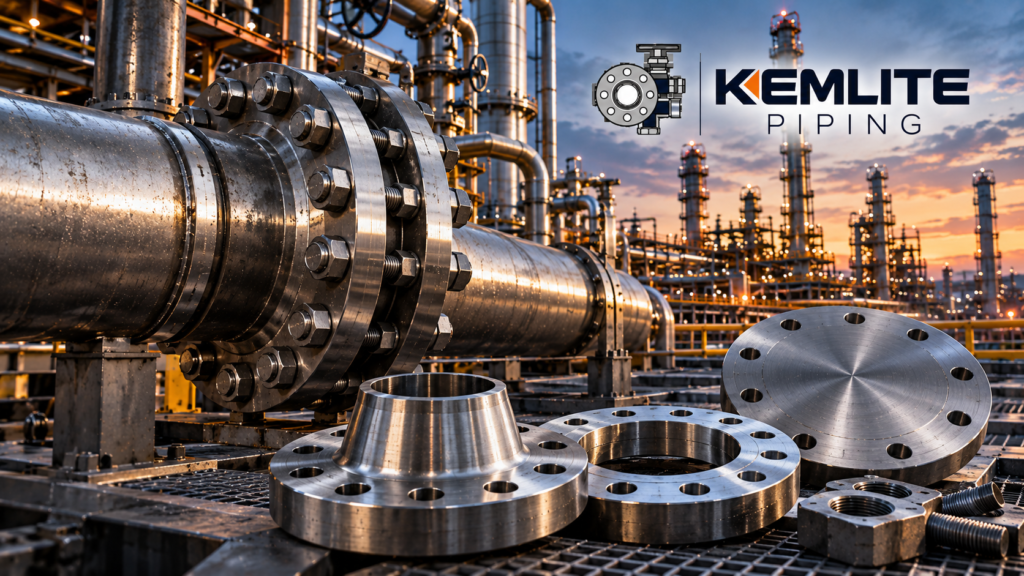
- weld neck flanges
- slip-on flanges
- RTJ flanges
- orifice flanges
and is offered in materials including carbon steel, low-temperature steel, stainless steel, duplex, super duplex, and other high-performance alloys.
The flange type should be selected based on the piping design.
Weld Neck Flanges
A weld neck flange has a long tapered hub that connects to the pipe through a butt weld.
This design is commonly considered in applications where the connection requires a smooth transition and where welding and stress considerations are important.
Weld neck flanges are often associated with demanding process and pressure applications.
However, the fact that a weld neck flange is generally considered a robust design does not mean it should automatically be selected for every system.
The project specification still determines the appropriate flange.
Kemlite lists weld neck raised-face and related flange configurations within its industrial flange offering.
Natural internal link: weld neck flanges
Slip-On Flanges
A slip-on flange is fitted over the pipe and welded into position according to the specified welding procedure.
The design can be useful where the piping system and fabrication requirements permit this connection method.
Slip-on flanges can be attractive for some general industrial applications because of their fabrication characteristics.
However, flange selection should still consider:
- pressure
- temperature
- cyclic loading
- piping stresses
- applicable code
- project specification
- installation requirements
It is not technically correct to say that slip-on flanges are simply “for low pressure.”
Their suitability has to be determined from the applicable standard and design conditions.
Blind Flanges
A blind flange is used to close the end of a piping system, nozzle, valve arrangement, or other flanged connection.
Unlike a flange intended to connect two open pipe sections, a blind flange has no through-bore for fluid flow.
This makes it useful when a line needs to be isolated or terminated and when the closure must be removable.
Blind flanges can also be important during:
- maintenance
- shutdowns
- equipment isolation
- testing
- future expansion
However, the forces acting on a blind flange should not be underestimated.
A blind flange is a pressure-containing closure, so the specified rating, material, thickness, facing, gasket and bolting requirements matter.
Kemlite currently lists blind flange configurations including BLRF within its flange range.
Natural internal link: blind flanges
Socket Weld Flanges
A socket weld flange is designed so that the pipe is inserted into a socket within the flange and then welded.
This type can be useful for smaller-diameter piping systems where the project design calls for a socket-welded connection.
As with all flange types, the applicable dimensional and pressure requirements need to be confirmed before purchase.
Kemlite lists socket weld raised-face flanges among its current product offerings.
RTJ Flanges
Ring Type Joint (RTJ) flanges use a metallic ring gasket installed in a specially machined groove.
ASME B16.20 covers metallic gaskets, including ring-joint gaskets, and states that the gaskets covered by the standard are dimensionally suitable for use with the reference flange standards including ASME B16.5 and ASME B16.47.
RTJ connections are used in applications where the project specification calls for this type of gasketed connection.
They should not be treated as simply a more expensive version of a raised-face flange.
The flange, groove, gasket, bolting, assembly procedure and mating components must all be compatible.
Kemlite lists RTJ flange designs within its current range.
Orifice Flanges
Orifice flanges are associated with differential-pressure flow measurement arrangements.
ASME B16.36 covers orifice flanges and includes pressure-temperature ratings, materials, dimensions, tolerances, testing and marking. ASME’s standards information identifies specific welding-neck and slip-on/threaded configurations and pressure classes covered by the standard.
The important point is that an orifice flange is not selected merely because an ordinary pipe flange is required.
The measurement arrangement, orifice assembly, pressure taps and applicable instrumentation design all need to be considered.
Kemlite currently lists orifice flanges in its industrial flange range.
Step 4: Select the Pressure Class
Pressure class is one of the most misunderstood parts of flange selection.
ASME B16.5 uses rating classes including:
150
300
400
600
900
1500
2500
with the size limitations specified by the standard.
A critical point is that a flange’s Class 300 designation is not simply a universal 300-psi pressure rating.
Pressure-temperature ratings vary with the material group and temperature.
The correct pressure-temperature rating must therefore be checked against the applicable standard and material.
This is why the statement:
“Class 300 means the flange can handle 300 psi.”
is not an adequate engineering explanation.
The class designation belongs to a standardized rating system.
Actual allowable pressure depends on the applicable rating tables and service temperature.
Pressure Class vs Working Pressure
It is useful to separate these terms.
Pressure class is the standardized flange rating designation.
Working pressure is the pressure the actual component/system may be permitted to operate at under the applicable design conditions.
A Class 600 flange at one temperature and material is not necessarily equivalent to another Class 600 flange at a different temperature and material.
The engineer must use the applicable pressure-temperature rating.
This is one of the reasons why a flange supplier should request both the material and the operating temperature instead of quoting only against the pipe size and class.
Step 5: Choose the Flange Material
The flange material must be compatible with the pipe, equipment and service.
Common industrial material families include:
Carbon steel
Used across many industrial piping systems where the service and design permit it.
Stainless steel
Used where corrosion resistance and other material properties are required.
Duplex stainless steel
Can be considered where a combination of mechanical strength and corrosion resistance is required.
Super Duplex
Used for more demanding corrosion environments where the project specification calls for the material.
Nickel alloys
Used in selected high-corrosion or specialized applications.
Kemlite’s current flange offering includes carbon steel, low-temperature steel, stainless steel, duplex, super duplex and high-performance alloy options.
This makes the material-selection stage particularly important for African and UAE projects where buyers may encounter both conventional carbon-steel systems and corrosion-resistant piping.
The Flange and Pipe Material Do Not Exist in Isolation
Suppose a project uses a stainless steel pipe.
It does not necessarily follow that the buyer can select any stainless steel flange.
The grade, temperature, corrosion environment, welding requirements, gasket, bolting and project specification still have to be checked.
The same applies to duplex piping.
For example, the material considerations discussed in our earlier guide on Duplex 2205 vs 316L stainless steel pipes also matter when selecting the associated flange material.
This is an important internal connection between pipe material selection and flange selection.
Step 6: Select the Flange Facing
The flange face is the sealing surface where the gasket or mating component contacts the flange.
The facing must match the mating flange and gasket arrangement.
Common arrangements encountered in industrial piping include:
- raised face
- flat face
- ring type joint
The correct face depends on the connection design and applicable specification.
A raised-face flange should not simply be connected to another flange because the pipe size and pressure class appear to match.
The mating components must be compatible.
Why Flange Facing Matters
The gasket does not work independently of the flange face.
The sealing system consists of:
Flange surface + gasket + bolt load + mating surface
The objective is to create and maintain an appropriate seal under the system’s pressure and temperature conditions.
ASME B16.20 covers metallic gaskets including ring-joint, spiral-wound and metal-jacketed gasket types, while ASME B16.21 covers nonmetallic flat gaskets.
Therefore, specifying the flange without specifying or confirming the gasket arrangement can leave an important part of the joint undefined.
Step 7: Select the Right Gasket
Gasket selection should be based on the application and flange arrangement.
Factors can include:
- fluid compatibility
- operating temperature
- pressure
- flange facing
- chemical environment
- gasket material
- applicable standard
- project requirements
For example, ASME B16.20 includes metallic ring-joint, spiral-wound and metal-jacketed gasket types, while ASME B16.21 covers nonmetallic flat gaskets.
The gasket should therefore be treated as part of the flange joint, not as an unrelated accessory.
Step 8: Confirm Bolt and Nut Requirements
A flange joint also depends on its bolting.
The bolt material, diameter, length, thread configuration and tightening procedure can all matter.
The bolting must be compatible with:
- flange material
- temperature
- pressure
- corrosion environment
- gasket requirements
- project specification
ASME B16.5 itself includes requirements and recommendations concerning flange bolting, gaskets and flange joints.
Kemlite also offers industrial fasteners in stainless steel, duplex, super duplex and other materials, with standards including ASTM A193/A194 and various coating options.
Natural internal link: industrial fasteners
This is a useful product-to-product internal link because the flange cannot be considered independently from its bolted joint.
Step 9: Check the Bore
The flange bore needs to be compatible with the connected piping.
This becomes particularly important with weld neck flanges because the flange bore is associated with the pipe dimensions and welding connection.
A flange should not be selected purely by nominal size.
Depending on the project, the purchaser may need to confirm:
- nominal pipe size
- outside diameter
- schedule
- wall thickness
- bore
- flange standard
This information becomes particularly important for larger or specialized piping systems.
Step 10: Check the Dimensional Standard
ASME B16.5 is widely used for NPS 1/2 through 24 pipe flanges and flanged fittings.
For larger-diameter steel flanges, ASME B16.47 covers NPS 26 through NPS 60.
This is an important distinction for large pipeline projects.
For a large-diameter pipeline in Africa or the Middle East, the buyer should not simply assume that a standard B16.5 flange is appropriate because the pressure class looks correct.
The dimensional standard must match the project requirement.
Step 11: Consider the Piping Code
The flange standard defines the flange product requirements.
The piping code governs the broader design context.
For example, ASME’s current standards catalog identifies B31.3 as the code for Process Piping and B31.1 as the code for Power Piping.
Other systems may be governed by other codes, regulations or project standards.
This distinction matters because a flange can conform to its product standard while the overall piping design still has additional requirements.
The engineer therefore needs to consider:
Flange standard + piping code + project specification + local regulations
rather than treating one standard as the entire design basis.
Flange Selection for Oil & Gas Systems
Oil and gas piping can include a wide variety of services.
Examples include:
- crude oil
- natural gas
- refined products
- produced water
- process chemicals
- steam
- utility systems
- cooling systems
- instrument systems
Each service may have different requirements.
A refinery, for example, can contain hundreds or thousands of piping connections operating under different conditions.
Therefore, simply asking for an oil and gas flange supplier does not define the technical requirement.
The procurement team should provide the relevant project specification.
Our earlier article, How to Choose Carbon Steel Pipes for Oil & Gas Projects in Nigeria, explains why pipe selection should start with service conditions, material, grade and standard. The same principle applies to flanges.
Flange Selection for African Oil & Gas Projects
For African markets such as Nigeria, Ghana, Tanzania, Kenya, South Africa and Egypt, buyers may source flanges for:
- upstream facilities
- pipelines
- terminals
- refineries
- petrochemical facilities
- gas processing
- power plants
- mining operations
- water infrastructure
The country alone does not determine flange selection.
A refinery project in Nigeria can have completely different requirements from a mining project in South Africa.
Similarly, an offshore facility can have requirements that differ substantially from an inland process plant.
The correct approach is therefore project-specific, not country-specific.
Nigerian Pipeline Projects and Flange Selection
Nigeria’s published oil and gas pipeline guidance addresses pipeline systems associated with petroleum exploitation, production, refining and product distribution and covers engineering, construction, operation and maintenance considerations.
That does not mean every flange on every Nigerian industrial project must follow the same specification.
Project-specific requirements and applicable regulations still need to be identified.
For an exporter supplying flanges to Nigerian projects, it is therefore important to establish:
- project specification
- applicable piping code
- material requirement
- pressure-temperature conditions
- dimensional standard
- flange type
- facing
- gasket requirements
- bolting
- inspection requirements
- documentation
Flange Selection for UAE Projects
The UAE has a broad industrial base covering oil and gas, petrochemicals, utilities, marine applications, infrastructure and industrial processing.
The same specification-led approach should be followed.
A UAE buyer may request:
ASME B16.5 Class 600 WNRF
but that still may not be enough information for a complete procurement decision.
The purchase specification may also require:
- material grade
- bore
- facing
- schedule
- gasket
- bolting
- supplementary testing
- inspection
- coating
- certification
This is particularly important for projects where the flange is part of a larger engineered piping package.
What Is an RF Flange?
“RF” normally refers to Raised Face.
You may therefore see descriptions such as:
WNRF — Weld Neck Raised Face
SORF — Slip-On Raised Face
BLRF — Blind Raised Face
Kemlite’s current flange range uses these types of designations in its product descriptions.
The abbreviation describes the flange configuration and facing.
The complete specification still needs the size, class, material and applicable standard.
What Does RTJ Mean?
RTJ means Ring Type Joint.
An RTJ flange uses a machined ring groove and a metallic ring gasket.
The relevant gasket requirements are covered by ASME B16.20, which specifically includes ring-joint gaskets.
RTJ should be specified when required by the piping design or project specification.
It should not be substituted casually for a raised-face arrangement.
The mating flange and gasket have to be designed for the same sealing system.
Why Material and Temperature Must Be Considered Together
A common mistake is selecting a flange material first and checking the operating temperature afterward.
The pressure-temperature rating of a flange is material-dependent.
Therefore, the sequence should be closer to:
Service → design pressure → design temperature → material → applicable rating → flange type
not:
Pipe size → Class 600 → choose any metal flange
ASME B16.5 specifically contains pressure-temperature rating requirements, which is why the material and temperature must be checked together.
Corrosion Considerations
For industrial flanges, corrosion can affect both the flange material and the integrity of the joint.
Potential issues depend on the environment and service.
These can include:
- atmospheric corrosion
- chloride exposure
- process-fluid corrosion
- galvanic effects
- corrosion under insulation
- crevice corrosion
A flange used in a coastal or offshore environment may require different material considerations from one used in a controlled indoor utility system.
The same principle applies to African mining and chemical-processing facilities.
Material selection should therefore follow the actual environment rather than the geographical label alone.
What About Galvanic Corrosion?
Galvanic corrosion can become a concern when dissimilar metals are electrically connected in the presence of an electrolyte.
This is especially relevant when a system combines different alloy families.
For example, the engineering team may need to consider compatibility between:
flange material + pipe material + bolts + gasket components + equipment connection
The correct approach depends on the actual material combination and environment.
Do not assume that using stainless steel for one component automatically eliminates corrosion concerns elsewhere in the joint.
Flange Selection for Marine Applications
Marine and offshore piping can introduce:
- seawater exposure
- chloride exposure
- salt spray
- humidity
- vibration
- temperature variation
- difficult maintenance conditions
Duplex and super duplex materials may be considered for certain applications where corrosion resistance and mechanical performance are important.
Kemlite currently offers duplex and super duplex flange materials as part of its product range.
The choice between stainless steel, duplex and super duplex should still be based on the project’s corrosion assessment and specification.
The material discussion in our earlier article on Duplex 2205 vs 316L is directly relevant here.
Flanges and Pipe Fittings Must Match the System
A flange does not exist alone in a piping system.
It can connect to:
- pipe
- valve
- elbow
- tee
- reducer
- equipment nozzle
- pump
- vessel
- other flanged components
That means flange selection needs to be coordinated with the rest of the piping package.
For example, a flange connection to a process valve needs to consider the valve’s end connection and applicable standard.
Kemlite also manufactures and supplies buttweld fittings, including elbows, tees, reducers, stub ends and caps.
Natural internal link: buttweld pipe fittings
Our seamless vs welded steel pipe guide also provides the background for understanding why the pipe manufacturing method must be considered alongside the connected fittings and flanges.
Flange Bolting Should Not Be an Afterthought
A properly specified flange still requires compatible bolting.
Factors include:
- bolt material
- nut material
- bolt diameter
- bolt length
- thread form
- coating
- temperature
- corrosion environment
- required preload
For critical piping systems, tightening procedures and bolt-load control can also be important.
Kemlite’s fastener range includes ASTM A193/A194 grades and stainless, duplex, super duplex and nickel-alloy options.
This is another reason an experienced flange supplier in Africa or UAE should be able to discuss the complete connection rather than simply quoting a flange body.
What Documents Should Be Requested?
Documentation depends on the project.
Typical requests can include:
- material test certificate
- certificate of conformity
- inspection report
- dimensional inspection
- heat traceability
- PMI where specified
- third-party inspection
- packing documentation
- marking information
Kemlite states that its export offering includes EN 10204 3.1 certification and third-party inspection, although the exact certification requirements should always be established in the purchase specification.
The important principle is:
Agree the documentation requirements before production, not after shipment.
What Should a Flange RFQ Look Like?
A vague RFQ:
Please quote 100 pieces of 6-inch flanges.
does not provide enough information for a proper industrial quotation.
A better RFQ could specify something like:
Product: Weld Neck Flange
Facing: Raised Face
Size: NPS 6
Pressure Class: Class 300
Material: As specified by project
Applicable Standard: ASME B16.5
Bore: As required for mating pipe
Quantity: 100
Inspection: Project requirement
Documentation: Project requirement
Destination: Nigeria
The values above are only an example of how to structure a purchase inquiry.
They should not be treated as a recommendation for a particular project.
Flange Selection Checklist
Before ordering an industrial flange, confirm the following.
1. Pipe size
What is the NPS?
2. Flange type
Weld neck, slip-on, blind, socket weld, RTJ, or another specified type?
3. Pressure class
What rating class is required?
4. Temperature
What are the design and operating temperatures?
5. Material
What exact grade is required?
6. Standard
ASME B16.5, B16.47, B16.36, API or another specification?
7. Facing
Raised face, flat face, RTJ, or other specified arrangement?
8. Bore
Does the bore match the connected pipe?
9. Gasket
Which gasket type and material are required?
10. Bolting
What bolt/nut material and dimensions are required?
11. Inspection
Is third-party inspection required?
12. Documentation
What certificates and traceability records are needed?
13. Coating
Is a coating or surface-treatment system required?
14. Destination
Where will the flange be installed?
A complete answer to these questions significantly reduces procurement ambiguity.
Common Flange Selection Mistakes
Mistake 1: Selecting by pipe size only
A 6-inch flange is not a complete product specification.
Mistake 2: Treating Class 300 as a fixed 300-psi rating
Pressure-temperature ratings depend on material and temperature.
Mistake 3: Mixing incompatible flange faces
The mating components and gasket arrangement must be compatible.
Mistake 4: Ignoring the bore
The flange needs to match the connected piping requirements.
Mistake 5: Selecting the material without considering the fluid
Material compatibility is part of the engineering decision.
Mistake 6: Choosing the gasket afterward
Gasket selection is part of the flange-joint design.
Mistake 7: Treating the flange separately from the bolts
Bolting is part of the joint.
Mistake 8: Using B16.5 when the project requires a large-diameter flange standard
ASME B16.47 addresses NPS 26 through NPS 60 large-diameter steel flanges.
Mistake 9: Assuming “stainless steel flange” is specific enough
The exact material grade matters.
Mistake 10: Buying before defining inspection and documentation
Certification requirements should be agreed before manufacturing and dispatch.
Frequently Asked Questions
How do I select the right pipe flange?
Start with the application and service conditions. Then establish pipe size, pressure, temperature, material, flange type, facing, applicable standard, gasket, bolting and project-specific inspection requirements.
What is ASME B16.5?
ASME B16.5 is the standard for pipe flanges and flanged fittings covering NPS 1/2 through NPS 24. It addresses pressure-temperature ratings, materials, dimensions, tolerances, marking and testing.
What is ASME B16.47?
ASME B16.47 is the standard for large-diameter steel flanges from NPS 26 through NPS 60.
What is a weld neck flange?
A weld neck flange has a tapered hub and is connected to the pipe through a butt weld. Its selection depends on the applicable design and project requirements.
What is an RTJ flange?
An RTJ flange uses a ring-type joint gasket seated in a machined groove. ASME B16.20 covers metallic ring-joint gaskets used with specified flange standards.
What is the difference between WNRF and SORF?
WNRF generally refers to a weld neck raised-face flange, while SORF refers to a slip-on raised-face flange.
Which flange is used for high-pressure piping?
The appropriate flange depends on the design conditions, material, temperature, pressure, applicable standard and project specification. It is not correct to select a flange type based solely on the phrase “high pressure.”
Is Class 600 the same for every flange material?
No. The pressure-temperature rating must be checked against the applicable material and standard.
Which standard covers orifice flanges?
ASME B16.36 covers orifice flanges and defines applicable requirements for ratings, materials, dimensions, tolerances, testing and marking.
What gasket should be used with an RTJ flange?
The gasket must be the appropriate metallic ring-joint gasket for the specified flange and groove arrangement. ASME B16.20 covers ring-joint gasket requirements.
Can a stainless steel flange be used with carbon steel pipe?
It can be possible in an appropriately engineered system, but material compatibility, welding/joining, corrosion, gasket, bolting and project requirements must be evaluated. It should not be assumed to be acceptable simply because the dimensions match.
Final Takeaway
The correct way to select a flange is not to start with:
“Which flange is strongest?”
or:
“Which flange is cheapest?”
Start with the piping system.
Identify the service.
Establish the design pressure and temperature.
Determine the pipe size and dimensions.
Select the required material.
Choose the flange type.
Confirm the pressure-temperature rating.
Match the flange facing and gasket.
Confirm the bolting.
Check the applicable dimensional and piping standards.
Then establish testing, inspection and documentation requirements.
ASME B16.5 provides the standardized requirements for many pipe flanges and flanged fittings from NPS 1/2 through NPS 24, while ASME B16.47 covers large-diameter steel flanges from NPS 26 through NPS 60.
For specialized connections, standards such as ASME B16.20 for metallic gaskets and ASME B16.36 for orifice flanges become part of the broader specification framework.
For African and UAE industrial projects, this specification-led approach is particularly important when sourcing from international suppliers.
The goal is not simply to find a flange supplier.
The goal is to obtain a flange that is:
dimensionally compatible, materially appropriate, correctly rated, properly sealed, adequately documented, and compliant with the project’s technical requirements.
That is what makes flange procurement reliable for demanding industrial piping systems.