When purchasing carbon steel pipe for an industrial or oil and gas project, two specifications that frequently appear in procurement discussions are ASTM A106 and API 5L.
Both are widely recognized specifications, but they are not interchangeable.
One of the most common procurement mistakes is to treat them as two different names for essentially the same carbon steel pipe. They are not.
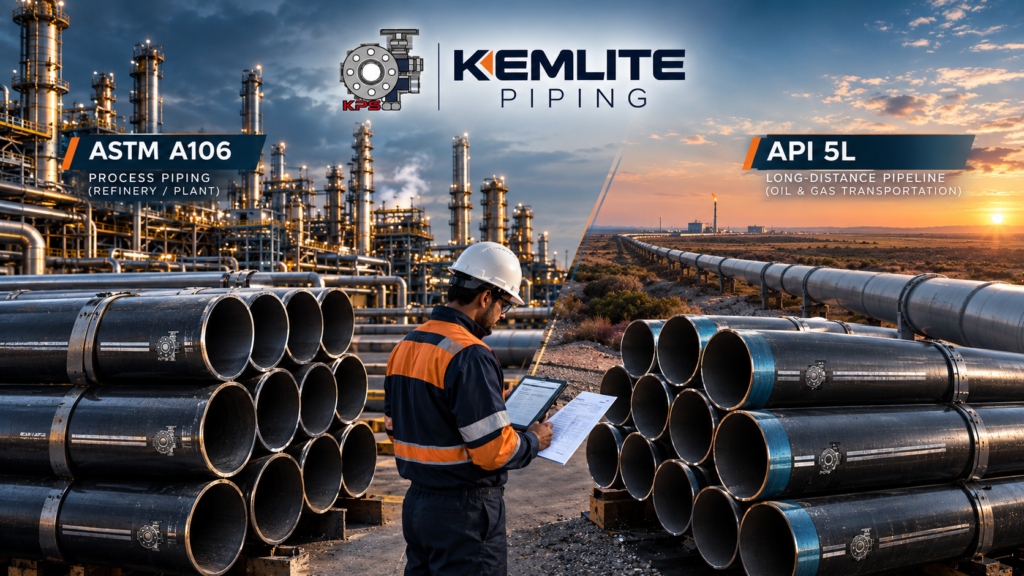
ASTM A106 is a specification for seamless carbon steel pipe for high-temperature service, while API 5L establishes requirements for seamless and welded steel line pipe intended for pipeline transportation systems in the petroleum and natural gas industries. ASTM currently lists A106/A106M-26 as its active edition, and API published the 47th edition of API Spec 5L in June 2026.
That difference in scope is the starting point for understanding which specification belongs on a purchase order.
The right question is not:
“Is ASTM A106 better than API 5L?”
The better question is:
“Which specification matches the service, piping system, design basis and project requirements?”
This guide explains the differences between the two standards, where each is commonly relevant, what ASTM A106 Grade B means, how API 5L Grade B and X grades fit into pipeline procurement, and what buyers in markets such as Nigeria should check before placing an order.
What Is ASTM A106?
ASTM A106/A106M is the standard specification for seamless carbon steel pipe for high-temperature service.
The current ASTM listing identifies A106/A106M-26 as the active specification. Its scope covers seamless carbon steel pipe for high-temperature service and includes NPS 1/8 through NPS 48, with dimensions referenced to ASME B36.10M and provisions for other dimensions when the requirements of the specification are satisfied.
This makes ASTM A106 particularly relevant to applications where seamless carbon steel pipe is required for elevated-temperature service.
It is frequently encountered in:
- process piping
- refinery systems
- petrochemical plants
- boilers and related high-temperature systems
- power and utility piping
- industrial process facilities
The exact application still has to be checked against the project’s design code and specification.
A pipe being manufactured to ASTM A106 does not mean it is automatically suitable for every high-temperature or high-pressure system.
What Is API 5L?
API Specification 5L is the American Petroleum Institute’s specification for line pipe.
API states that API Spec 5L establishes requirements for the manufacture of seamless and welded steel pipe used in pipeline transportation systems in the petroleum and natural gas industries. The specification addresses material requirements as well as manufacturing, inspection, testing, marking and traceability.
API published the 47th edition of API Spec 5L on June 2, 2026. API says the new edition introduced changes across more than 15 technical areas, including high-frequency-weld pipe quality, sour-service requirements, impact toughness, sulfide-stress-cracking testing, lamination control, and requirements associated with carbon-dioxide transmission pipelines.
That is particularly relevant for current procurement.
A buyer issuing an API 5L purchase specification in 2026 should establish the edition and project requirements rather than assuming that an older edition is automatically acceptable.
ASTM A106 vs API 5L: The Fundamental Difference
The easiest way to understand the two specifications is to look at their intended scope.
| Feature | ASTM A106 | API 5L |
|---|---|---|
| Primary scope | Seamless carbon steel pipe for high-temperature service | Steel line pipe for petroleum and natural gas pipeline transportation |
| Seamless pipe | Yes | Yes |
| Welded pipe | No under A106 | Yes |
| Typical context | Process/high-temperature piping | Pipeline transportation |
| Carbon steel | Yes | Yes, across specified grades |
| Grade examples | A, B, C | Grade B, X42, X52, X60, X65, X70 and other specified grades |
| Pipe sizes | NPS 1/8 to 48 within A106 scope | As specified by API 5L/project requirements |
| Primary procurement question | Is seamless carbon steel pipe for the specified high-temperature service required? | Is line pipe complying with the pipeline specification required? |
The key point is this:
ASTM A106 describes a particular type of seamless carbon steel pipe and its requirements.
API 5L describes line pipe intended for a specific transportation application and includes both seamless and welded manufacturing routes.
API’s current webstore description explicitly identifies two product specification levels, PSL 1 and PSL 2, for seamless and welded steel pipes covered by API 5L.
ASTM A106 Is Not an API 5L Substitute
Suppose a project specification calls for:
API 5L X52 line pipe
A supplier should not simply respond:
“We can provide ASTM A106 Grade B instead.”
That is not a like-for-like substitution.
The two specifications have different scopes and requirements.
Similarly, if a process piping project specifies:
ASTM A106 Grade B seamless pipe
the buyer should not assume that any API 5L pipe is automatically an equivalent replacement.
Any substitution has to be evaluated against the project’s design, code, specification and approval process.
This is especially important on engineered projects where material substitutions can affect:
- design calculations
- welding procedures
- inspection
- certification
- documentation
- traceability
- regulatory acceptance
- client approval
What Is ASTM A106 Grade B?
ASTM A106 Grade B is one of the grades covered by the ASTM A106 specification.
The important thing to understand is that Grade B is not itself a complete pipe specification.
A procurement request may still need to define:
- pipe size
- wall thickness
- schedule
- length
- end preparation
- quantity
- testing
- inspection
- documentation
- supplementary requirements
ASTM’s A106 scope specifically allows optional supplementary requirements that apply when they are specified by the purchaser.
So:
“A106 Grade B”
is useful information, but it is not necessarily the complete purchasing specification.
Why ASTM A106 Grade B Is Commonly Requested
Grade B is frequently encountered in industrial carbon steel piping specifications because ASTM A106 is specifically designed for seamless carbon steel pipe for high-temperature service.
ASTM states that A106 pipe is intended to be suitable for bending, flanging and similar forming operations and for welding, provided an appropriate welding procedure is used for the material and intended service.
This can make A106 relevant to process piping where engineers require seamless carbon steel pipe.
However, “high temperature” should not be interpreted as “all high-temperature applications.”
The material still has to be evaluated against the actual design temperature, pressure, fluid, piping code and project requirements.
What Is API 5L Grade B?
API 5L uses its own grading system.
One grade encountered in procurement is:
API 5L Grade B
The API 5L family also includes higher-strength X grades such as:
- X42
- X52
- X60
- X65
- X70
among other specified grades and product configurations.
API’s licensing information identifies examples including Grade B, X52 and X90 among capable grades, and distinguishes pipe types such as HFW, SAWL and SMLS.
The “X” designation in API 5L therefore belongs to the API line-pipe grading system.
It should not be treated as a direct equivalent to the Grade B designation used in ASTM A106.
API 5L Grade B vs ASTM A106 Grade B
This is one of the most important points in this article.
Both specifications can contain a Grade B, but:
ASTM A106 Grade B and API 5L Grade B are not simply the same pipe.
The specification behind the grade matters.
A material designation has meaning only in the context of the standard in which it is defined.
Therefore:
ASTM A106 Grade B ≠ API 5L Grade B
even though both contain the words “Grade B.”
For procurement, always write the full specification and grade.
ASTM A106 vs API 5L for Oil and Gas
The answer depends on what part of the oil and gas system you are talking about.
An oil and gas facility can contain:
- process piping
- gathering systems
- transmission pipelines
- utility piping
- refinery process lines
- gas-processing systems
- terminal piping
- water and chemical systems
Those systems do not necessarily use the same pipe specifications.
For a pipeline transportation application covered by API 5L, the API specification may be central to the line-pipe procurement.
For a refinery or process-plant piping application, other material and piping standards may be specified depending on the service and design code. ASTM A106 may be relevant where seamless carbon steel pipe for high-temperature service is required.
This is why saying:
“It’s an oil and gas project, so use API 5L.”
is too simplistic.
The actual piping system determines the requirement.
API 5L Is Specifically Associated With Pipeline Transportation
API’s description of Spec 5L is important because it defines the intended application.
The specification establishes requirements for seamless and welded steel pipe used in pipeline transportation systems in the petroleum and natural gas industries.
That makes API 5L particularly relevant when the pipe is part of a line-pipe system transporting petroleum or natural gas.
This is different from saying that all piping inside an oil and gas facility must be API 5L.
For example, an internal refinery process line and a long-distance transmission pipeline are fundamentally different engineering contexts.
Seamless vs Welded Under API 5L
One of the major differences between A106 and API 5L is manufacturing scope.
ASTM A106 covers seamless carbon steel pipe.
API 5L covers seamless and welded steel pipe.
API’s licensing documentation identifies pipe types including:
- HFW
- SAWL
- SMLS
among others.
This provides another reason not to compare API 5L and ASTM A106 simply by grade name.
The manufacturing route is part of the product specification.
Our earlier article, Seamless vs Welded Steel Pipes, explains this distinction in greater detail.
What Does PSL Mean in API 5L?
API 5L includes two Product Specification Levels, commonly referred to as:
PSL 1
and
PSL 2
API’s current webstore description explicitly identifies these two product specification levels for seamless and welded steel pipe.
The presence of PSL levels is another indication that an API 5L specification involves more than simply choosing a material grade.
Depending on the project, additional requirements can apply to:
- chemical composition
- mechanical properties
- testing
- impact toughness
- nondestructive evaluation
- traceability
- manufacturing controls
- sour service
- other supplementary requirements
The purchaser should therefore state the required PSL rather than simply writing “API 5L.”
Why PSL 2 Requires More Attention
PSL 2 is associated with more extensive specification requirements than PSL 1, including additional controls and testing depending on the product and application.
API’s current 47th-edition announcement lists updates involving impact toughness, non-destructive evaluation, sour-service requirements, chemical element ranges, sulfide-stress-cracking testing, hydrotest gauge calibration and other quality-related areas.
This does not mean PSL 2 should automatically be selected for every project.
The project specification determines the required level.
A buyer should never upgrade or downgrade between PSL levels without confirming the engineering and contractual requirements.
ASTM A106 vs API 5L: What About Pressure?
Neither specification should be reduced to a simple statement such as:
“A106 is for high pressure.”
or:
“API 5L is stronger.”
Pressure capability depends on much more than the specification name.
It can be influenced by:
- material grade
- pipe dimensions
- wall thickness
- design temperature
- allowable stress
- design code
- manufacturing requirements
- corrosion allowance
- loading conditions
- project-specific requirements
ASME B36.10M provides standardized dimensions for welded and seamless wrought steel pipe, and ASTM A106 references those dimensions within its scope for nominal wall thickness.
The actual pressure design has to be established through the applicable engineering code and project calculations.
ASTM A106 vs API 5L: What About Temperature?
Temperature is particularly relevant to ASTM A106 because its scope specifically addresses high-temperature service.
That does not mean API 5L has no temperature considerations.
Pipeline systems also operate across different environments and temperature conditions, and API 5L contains requirements associated with material properties, testing and service considerations.
The difference is the primary purpose and scope of the standards.
A106 is specifically a seamless carbon steel pipe specification for high-temperature service.
API 5L is specifically a line-pipe specification for petroleum and natural gas transportation.
ASTM A106 vs API 5L for Refinery Piping
A refinery contains many different piping systems.
Process piping can be exposed to:
- elevated temperatures
- high pressure
- hydrocarbons
- process chemicals
- hydrogen
- corrosive compounds
- changing operating conditions
ASTM A106 can be relevant where the project calls for seamless carbon steel pipe for high-temperature service.
But the complete piping design may involve multiple other standards as well.
The pipe specification should therefore be selected by the engineering team based on the actual service.
The phrase “refinery pipe” does not identify one universal specification.
ASTM A106 vs API 5L for Transmission Pipelines
The situation is different for pipeline transportation.
API 5L is specifically designed for line pipe used in petroleum and natural-gas transportation systems.
For these projects, procurement may involve requirements concerning:
- line-pipe grade
- PSL
- seamless or welded manufacturing route
- dimensions
- delivery condition
- impact requirements
- testing
- inspection
- traceability
- sour-service requirements where applicable
- project-specific supplementary requirements
For a transmission pipeline, asking a supplier for “ASTM A106 Grade B pipe” simply because it is seamless carbon steel would not be enough.
The project specification should govern.
ASTM A106 vs API 5L for Process Piping
Process piping is another situation where the distinction becomes important.
The design may specify a seamless carbon steel pipe standard suitable for the process conditions.
ASTM A106 is specifically written for seamless carbon steel pipe for high-temperature service.
The engineer may then coordinate the pipe specification with the applicable piping code, such as ASME B31.3 where applicable.
The key is to distinguish:
material/product specification
from:
piping design code
and from:
project specification
They are related, but they are not the same document.
ASTM A106 vs API 5L for Nigeria
For buyers and EPC contractors working on Nigerian oil and gas projects, understanding this distinction is particularly important.
Nigeria’s published pipeline guidance applies to pipeline systems associated with petroleum exploitation, production, refining and product distribution and includes requirements around design, construction, operation and maintenance.
This means a project may need to satisfy:
international product standards + engineering codes + Nigerian requirements + client specifications
A supplier should therefore ask for the project specification before deciding whether A106 or API 5L is appropriate.
The country is not enough information.
A pipeline project in Nigeria and process piping inside a Nigerian refinery can have different pipe specifications.
What About South Africa, Ghana, Tanzania and Kenya?
The same principle applies across African markets.
A buyer may search for:
API 5L pipe supplier South Africa
or:
ASTM A106 pipe supplier Nigeria
or:
carbon steel pipe supplier Tanzania
Those search terms indicate commercial intent, but they do not establish the technical specification for a real project.
The supplier still needs to understand:
- application
- project standard
- grade
- dimensions
- pressure
- temperature
- testing
- inspection
- documentation
- destination
This is where a technically strong supplier page can outperform a generic “steel pipe exporter” page.
Why African Buyers Should Be Careful With Supplier Terminology
International suppliers sometimes use phrases such as:
- API pipe
- ASTM pipe
- carbon steel pipe
- seamless pipe
- line pipe
- oil and gas pipe
These are useful commercial descriptions but can be too broad for project procurement.
For example:
“API pipe”
does not tell you whether the quotation is API 5L, what grade is being supplied, what PSL applies, or whether the pipe is seamless or welded.
Likewise:
“ASTM carbon steel pipe”
does not tell you whether the supplier is quoting A106, A53 or another specification.
Always request the exact standard.
ASTM A53 Is Another Specification Buyers Should Not Confuse With A106
A third standard frequently appears in carbon steel pipe procurement:
ASTM A53/A53M
The current ASTM listing identifies A53/A53M-24 as the active edition and states that it covers seamless and welded black and hot-dipped galvanized steel pipe in NPS 1/8 through NPS 26. The specification describes pipe intended for mechanical and pressure applications and also identifies ordinary uses in steam, water, gas and air lines.
This is useful because it demonstrates why “carbon steel pipe” is not enough information.
A buyer could be looking at:
ASTM A53
ASTM A106
or
API 5L
depending on the application.
The appropriate standard depends on the project.
ASTM A106 vs A53 vs API 5L
A simplified comparison is useful.
| Standard | Basic scope | Seamless | Welded |
|---|---|---|---|
| ASTM A53/A53M | Black / galvanized welded and seamless steel pipe within the specification’s scope | Yes | Yes |
| ASTM A106/A106M | Seamless carbon steel pipe for high-temperature service | Yes | No |
| API 5L | Line pipe for petroleum and natural gas pipeline transportation | Yes | Yes |
ASTM A53’s current specification is A53/A53M-24, ASTM’s active listing shows A106/A106M-26, and API’s current line-pipe standard is API Spec 5L, 47th edition, published in 2026.
This table is a starting point, not a substitute for the actual scope and requirements of each standard.
Can ASTM A106 Pipe Be Used in a Pipeline?
This should not be answered with an automatic yes or no.
The first question is:
What does the governing project specification require?
A pipeline transportation system governed by API 5L may require line pipe to that specification.
A process or facility piping system may use other pipe specifications depending on the design.
The important distinction is that A106 and API 5L have different primary scopes.
Never substitute one for the other simply because the material appears similar.
Can API 5L Pipe Be Used for Process Piping?
Again, the project specification determines that.
API 5L is specifically a line-pipe specification for petroleum and natural gas pipeline transportation.
A process piping system may instead specify ASTM material standards together with the applicable ASME piping code.
An engineer may determine that a particular line-pipe material is technically suitable in another application, but that would be a project-specific engineering decision.
The supplier should not make that substitution independently.
What Should a Supplier Ask Before Quoting ASTM A106?
A serious RFQ should include:
Specification: ASTM A106/A106M
Grade: Grade B, if specified
Product: Seamless pipe
Size: NPS / required dimensions
Wall thickness: Schedule or actual required wall thickness
Length: Required length
Ends: Plain, beveled or as specified
Testing: Applicable requirements
Inspection: Project requirements
Documentation: Required certificates
Quantity: Required quantity
Destination: Country and delivery location
The supplier should quote exactly what the buyer has specified.
What Should a Supplier Ask Before Quoting API 5L?
A line-pipe RFQ should be more detailed.
For example:
Specification: API Spec 5L
Edition: Project-required edition
Grade: B / X42 / X52 / X60 / etc.
PSL: PSL 1 or PSL 2
Pipe type: Seamless / HFW / SAWL / other permitted type
Size: Required diameter
Wall thickness: Required wall thickness
Length: Required length
Delivery condition: As specified
Testing: API/project requirements
Inspection: Project requirements
Sour service: State where applicable
Documentation: Certificates and traceability requirements
Quantity: Required quantity
Destination: Project delivery location
API’s current licensing information itself distinguishes pipe type, delivery condition, highest capable grade and specific service annexes, demonstrating the degree of detail that may be involved in API 5L procurement.
Why Traceability Matters
For industrial piping, the buyer needs to be able to establish what material was supplied and how it relates to the purchase specification.
This becomes particularly important in oil and gas projects where documentation and traceability can form part of the inspection and quality-control process.
API states that Spec 5L includes requirements covering marking and traceability in addition to manufacturing, inspection and testing.
Kemlite states that its pipe offering includes EN 10204 3.1 material certification and third-party inspection.
The exact documents required for an individual project should still be specified in the purchase order.
What Is More Important: ASTM or API?
Neither standard is “better.”
They answer different procurement requirements.
If the project requires seamless carbon steel pipe for high-temperature service, ASTM A106 may be the relevant material specification.
If the project requires line pipe for petroleum or natural gas pipeline transportation, API 5L may be the relevant specification.
The standard should therefore be selected according to the engineering requirement.
A Simple Decision Framework
Use this sequence before contacting a pipe supplier.
Question 1: What is the pipe doing?
Is it:
- process piping?
- pipeline transportation?
- utility piping?
- refinery piping?
- gas transportation?
- another industrial service?
Question 2: What is the service?
Identify:
- fluid
- temperature
- pressure
- corrosion environment
Question 3: What standard does the project specify?
Possible examples:
ASTM A106
ASTM A53
API 5L
or another applicable standard.
Question 4: What grade is required?
For example:
A106 Grade B
or
API 5L X52
Question 5: What manufacturing route is permitted?
For API 5L, this could involve seamless or an approved welded form depending on the project.
Question 6: What testing and inspection are required?
Define these before placing the order.
Question 7: What documentation is required?
Establish certificates, traceability and inspection requirements.
Example 1: Refinery Process Piping
Imagine an engineering specification calls for:
Seamless carbon steel pipe for high-temperature service
The project’s material specification identifies:
ASTM A106 Grade B
The procurement team should then source pipe that meets the specified ASTM requirements and the dimensions, testing and documentation required by the project.
This is a very different procurement exercise from sourcing API 5L line pipe.
Example 2: Natural Gas Transmission Pipeline
Now consider a transmission pipeline project where the engineering specification calls for:
API 5L X52 PSL 2 line pipe
The supplier needs to quote against the API 5L requirement, including the required pipe type, dimensions, PSL and project-specific requirements.
The supplier should not replace the requirement with A106 Grade B simply because both are carbon steel pipe products.
Example 3: Buyer Requests “Carbon Steel Pipe”
Suppose a buyer sends:
Need 1,000 meters of carbon steel pipe for an oil project.
This is not enough information.
The supplier should ask:
What application?
Which standard?
Which grade?
Seamless or welded?
What size?
What schedule or wall thickness?
What inspection?
What documentation?
Where is the delivery location?
This approach prevents a quotation that looks commercially attractive but turns out to be technically unsuitable.
A Major Procurement Mistake: “Equivalent” Without Engineering Approval
Suppliers sometimes describe different standards as “equivalent.”
This term should be used carefully.
A material may have comparable chemistry or mechanical properties without being a contractual or engineering equivalent.
For example, a pipe that appears similar in:
- carbon content
- tensile strength
- yield strength
- dimensions
may still have different requirements for:
- manufacturing
- testing
- inspection
- traceability
- acceptance criteria
- service
- certification
That is why substitution should be approved by the responsible engineering/client organization.
How This Relates to Seamless vs Welded Pipe Selection
The manufacturing method is directly connected to this discussion.
Our first article, Seamless vs Welded Steel Pipes: Which Is Better for Oil & Gas Projects in Africa?, explains why seamless and welded construction should not be judged through a simple “stronger versus weaker” comparison.
ASTM A106 is specifically a seamless pipe specification.
API 5L, by contrast, covers seamless and welded line pipe.
This is one of the clearest practical differences between the two standards.
How This Relates to Carbon Steel Pipe Selection in Nigeria
For Nigerian oil and gas projects, the material-selection principles discussed in our carbon steel pipe guide for Nigeria are directly relevant.
The buyer should identify:
application → service → standard → grade → dimensions → testing → inspection
before requesting a quotation.
That is also why a Nigeria-specific landing page for carbon steel pipes should explain specifications rather than simply saying that the supplier exports to Nigeria.
How This Relates to Duplex and Stainless Steel
Not every industrial piping application should use carbon steel.
Our earlier article on Duplex 2205 vs 316L stainless steel pipes covers situations where corrosion resistance and material selection become more important.
If the service contains demanding chloride exposure or other corrosive conditions, the engineering team may evaluate stainless, duplex, super duplex or other alloys rather than simply choosing between A106 and API 5L.
The pipe standard is therefore only one part of the broader material-selection process.
How This Relates to Flanges and Other Piping Components
Pipe selection also affects the rest of the piping package.
A piping system may include:
Our guide to selecting pipe flanges explains why pressure class, material, facing, gasket, bolting and applicable standards need to be evaluated together.
Kemlite’s current product portfolio includes pipes and tubes, flanges, buttweld fittings, valves, fasteners and branch-connection products.
This allows an industrial supplier to support the wider piping package rather than treating the pipe as an isolated component.
What African Buyers Should Look for in a Supplier
For an African EPC contractor, stockist or procurement team, a technically capable supplier should be able to respond clearly to questions such as:
Can you supply ASTM A106 Grade B?
Can you supply API 5L X52?
Can you supply PSL 2?
Can you supply seamless and welded options where permitted?
Can you provide material certificates?
Can you support third-party inspection?
Can you provide full traceability?
Can you package the material for international shipment?
Can you quote delivery to Nigeria, South Africa, Ghana, Tanzania or another destination?
The supplier’s ability to understand the specification is often more important than a generic statement such as “we supply all types of pipes.”
What About UAE Procurement?
The same technical principles apply to UAE projects.
The UAE has substantial oil and gas, petrochemical, energy and industrial infrastructure, but the appropriate pipe specification still depends on the project.
A UAE buyer may search for:
- ASTM A106 pipe supplier UAE
- ASTM A106 Grade B supplier Dubai
- API 5L pipe supplier UAE
- API 5L X52 supplier UAE
- seamless carbon steel pipe UAE
These are commercially meaningful search terms, but the actual order still has to be based on the engineering specification.
The country changes the logistics and commercial context.
It does not change the fundamental technical definition of the pipe.
Frequently Asked Questions
What is the difference between ASTM A106 and API 5L?
ASTM A106 is a specification for seamless carbon steel pipe for high-temperature service. API 5L is a line-pipe specification covering seamless and welded steel pipe for petroleum and natural gas pipeline transportation systems.
Is ASTM A106 Grade B the same as API 5L Grade B?
No. Both use the designation Grade B, but they are grades defined within different standards and should not be treated as automatically interchangeable.
Is API 5L seamless?
API 5L covers both seamless and welded steel line pipe.
Is ASTM A106 seamless?
Yes. ASTM A106 specifically covers seamless carbon steel pipe for high-temperature service.
Is API 5L only for oil and gas?
Its stated scope is line pipe used in pipeline transportation systems in the petroleum and natural gas industries.
What is ASTM A106 Grade B used for?
It is a grade within ASTM A106, which covers seamless carbon steel pipe for high-temperature service. The actual application still needs to satisfy the project specification and applicable piping design requirements.
What is API 5L X52?
X52 is one of the grade designations used within API 5L line-pipe procurement. The complete requirement can also include PSL, pipe type, delivery condition, testing and other project-specific requirements.
What does PSL 2 mean in API 5L?
PSL 2 is one of the two product specification levels identified by API for Spec 5L. It includes additional requirements beyond the basic PSL structure, depending on the applicable pipe and service requirements.
Is ASTM A53 the same as ASTM A106?
No. ASTM A53 covers welded and seamless black and hot-dipped galvanized steel pipe within its scope, while ASTM A106 covers seamless carbon steel pipe for high-temperature service. The current active A53 edition is A53/A53M-24.
Which is stronger: A106 Grade B or API 5L X52?
This is not a useful standalone comparison. They belong to different specifications and applications. Mechanical properties, dimensions, design conditions and the governing code must be evaluated for the specific application.
Can I replace ASTM A106 with API 5L?
Do not make that substitution without engineering and client approval. The standards have different scopes and requirements.
Which pipe should I buy for a Nigerian oil and gas project?
The answer depends on the actual application and project specification. A transmission pipeline may require API 5L, while process piping may use another specified pipe standard such as ASTM A106. The engineering specification should determine the choice.
Does API 5L 47th edition matter for current procurement?
Yes. API announced the publication of the 47th edition on June 2, 2026. Buyers should establish which edition is contractually required and whether their project specification has been updated accordingly.
Final Takeaway
The comparison between ASTM A106 and API 5L is not really a competition between two steel pipe standards.
They are designed around different requirements.
ASTM A106/A106M is a specification for seamless carbon steel pipe for high-temperature service. The current active edition listed by ASTM is A106/A106M-26.
API Specification 5L is a specification for seamless and welded steel line pipe used in petroleum and natural gas pipeline transportation systems. API published the 47th edition in June 2026.
So the practical rule is:
For a process or high-temperature piping requirement
Start by checking whether the engineering specification calls for ASTM A106 or another applicable material standard.
For a petroleum or natural-gas pipeline transportation requirement
Check whether API 5L is the governing line-pipe specification and establish the required grade, PSL and manufacturing route.
For either application
Never specify only:
“carbon steel pipe”
or:
“Grade B pipe.”
Specify the complete technical requirement.
That should include:
standard + grade + manufacturing method + size + wall thickness + length + testing + inspection + documentation
The same principle applies whether the project is in Nigeria, South Africa, Ghana, Tanzania, Kenya, Egypt or the UAE.
For buyers, the objective is not to find a pipe that merely looks equivalent.
The objective is to source a pipe that matches the engineering specification, service conditions, applicable standard and project documentation requirements.
For suppliers such as Kemlite, that creates an important opportunity: technical SEO should target searches such as ASTM A106 Grade B pipe supplier, API 5L pipe supplier, API 5L X52 pipe supplier Nigeria, and related specification-led queries because those searches are much closer to genuine industrial procurement intent than a generic “carbon steel pipe” search.
Kemlite’s current pipe portfolio already references ASTM A106, ASTM A53 and API 5L along with carbon-steel grades and multiple pipe manufacturing options, giving the site a strong product foundation for this topic cluster.