Thermal power stations in Cairo, Egypt, and heavy industrial boilers in Johannesburg, South Africa, run under brutal operating conditions. When a facility pushes superheated steam or hot process gases through a pipeline, the connection points take the brunt of the punishment. Standard stainless grades like 304 or 316 begin to lose their structural strength and suffer from heavy scaling once temperatures climb past 800°C.
To prevent catastrophic joint failure in high-heat zones, plant engineers specify SS 310. Because of its high chromium and nickel content, SS 310 offers exceptional resistance to oxidation and sulfidation at extreme temperatures. However, choosing the right steel grade is only half the battle; the physical design of the flange is equally critical.
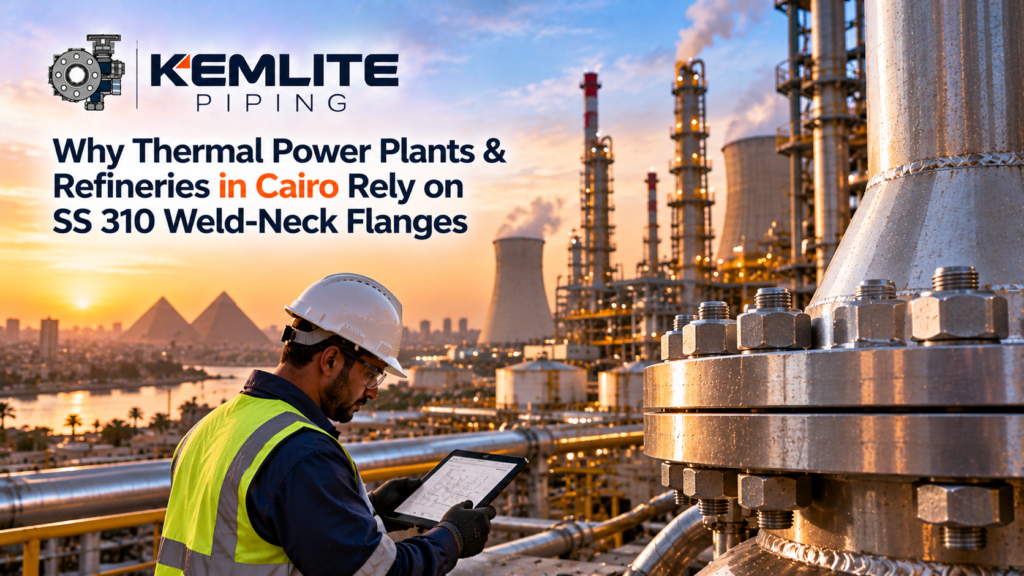
For high-temperature, high-pressure lines, flat-face or slip-on flanges are a major liability. Instead, critical service applications require stainless steel weld-neck flanges. A weld-neck flange is immediately recognizable by its long tapered hub. This hub is engineered to transfer mechanical stress away from the flange face and distribute it evenly into the pipe wall itself.
When thermal pipelines heat up and cool down, they expand and contract. The tapered hub of a weld-neck flange handles this repeated bending and high pressure without cracking the weld seam. Furthermore, the inner bore of the flange matches the exact inner diameter of the connecting pipe. This smooth transition from flange to pipe maintains flow efficiency, prevents turbulence, and eliminates erosion inside the joint. Once butt-welded into place, it creates a permanent, vibration-resistant, and leak-proof seal.
Kemlite Piping Solution maintains ready stock of weld-neck flanges in SS 310, alongside grades 304, 304L, 316, 316L, 321, and 347. We supply sizes ranging from 1/2″ all the way up to 48″ across pressure classes 150#, 300#, 600#, 900#, 1500#, and 2500#. Just as power plant managers rely on our Inconel boiler tubes in Egypt to stop tube meltdowns, EPC contractors across North and South Africa trust our third-party inspected flanges to keep their high-pressure steam lines sealed and operational.