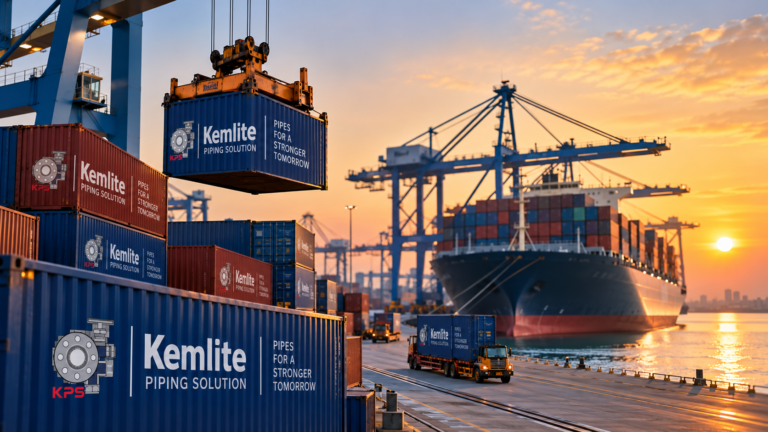
If you’re sourcing pipe fittings, flanges, or valves for a project in the UAE, importing directly from an Indian manufacturer is very likely the smartest move you can make on your procurement budget — but only if you know exactly what you’re doing. Get the documentation wrong, underestimate landed cost, or pick a trading company instead of a real manufacturer, and a straightforward order turns into a customs delay, a failed inspection, or a quote that quietly balloons once freight and duty are added.
This guide walks through the entire import process — from choosing the right supplier and material grade, through documentation and customs clearance, to what it actually costs to land a shipment in Dubai, Abu Dhabi, or Sharjah. We manufacture and export pipe fittings, flanges, and valves directly from India to the UAE, so this is written from the supplier side of that process — the questions UAE buyers actually ask us, and where orders most commonly go wrong when they’re placed with the wrong partner.
Why UAE Buyers Import Pipe Fittings & Flanges from India
The UAE’s oil & gas, petrochemical, desalination, and construction sectors consume a huge volume of piping components every year — and very little of it is manufactured locally. That means almost every EPC contractor, MEP contractor, and industrial buyer in the UAE is importing, whether from Europe, China, or India. India has become the preferred source for a specific reason: it’s the only origin that combines internationally recognized manufacturing standards with genuinely competitive pricing.
- Lower manufacturing cost without lower quality — Indian mills and forging units produce to the same ASME, ASTM, and API standards as European suppliers, at a materially lower cost base, which shows up directly in your landed price.
- Faster lead times than Europe — shorter production queues and more flexible custom-order capacity than larger European manufacturers running standardized batch production.
- Shorter shipping distance than China for many UAE ports — Mumbai to Jebel Ali is one of the shortest major sea freight routes into the UAE, which keeps both cost and transit time down.
- A manufacturing base built for export — Indian piping manufacturers, including Kemlite, are structured around ISO 9001:2008 certified processes and EN10204 3.1 material certification specifically because international buyers require it as standard.
The catch: the Indian piping export market is large and uneven in quality. Some suppliers are genuine manufacturers with in-house forging, machining, and QC. Many others are trading companies reselling someone else’s output at a markup, with no real control over quality or lead time. Getting this distinction right is the single biggest factor in whether your import goes smoothly.
Step 1: Define What You’re Actually Importing
Before requesting quotes, nail down the exact specification — this is where most delays and re-quotes happen. At minimum, you need:
- Product type and size range — e.g. weld neck flanges in 4″ to 12″ NB, or buttweld elbows to ASME B16.9
- Material grade — stainless steel (304/316), duplex or super duplex for higher chloride resistance, or a nickel alloy for more aggressive process conditions
- Pressure class and design standard — ASME B16.5, API 6D, MSS SP-97, etc., depending on the product
- Applicable end-use standard — many UAE projects (ADNOC, DEWA, and major EPC contractors) reference specific approved vendor lists or project specs; even if you’re not on a formal approved list, quoting to the exact standard referenced in your project spec avoids rejected shipments at inspection
If you’re unsure which grade fits your application — for example, whether standard stainless steel is sufficient for a desalination or offshore project, or whether you need duplex 2205 or super duplex 2507 for better chloride stress corrosion resistance — this is exactly the kind of question a real manufacturer should be able to answer on a call before you commit to a quote, not after.
Step 2: Choose a Manufacturer, Not a Trading Company
This is the step that determines everything downstream — pricing, lead time, documentation quality, and whether your shipment passes inspection without issue.
How to tell the difference:
- A manufacturer can tell you which of their own facilities produces your specific item, and can usually arrange a factory visit or video walkthrough
- A manufacturer controls their own material traceability — ask for a sample EN10204 3.1 certificate before ordering and check it references their own facility, not a third party
- A manufacturer can quote custom, non-catalog sizes with a real lead time, because they control production scheduling — a trading company has to check with someone else first, and that delay usually shows up in their quote response time too
At Kemlite Piping Solution, every order ships from our own ISO 9001:2008 certified manufacturing process — not a resold batch from an unnamed third-party mill. That’s a meaningful part of why our pricing is competitive: there’s no middleman markup sitting between you and the factory floor. We manufacture across the full range a UAE piping project typically needs — valves, flanges, buttweld fittings, fasteners, olets, and dielectric unions — so most UAE buyers can consolidate what would otherwise be three or four separate supplier relationships into one shipment, one set of documentation, and one freight invoice.
Step 3: Get the Documentation Right From the Start
This is where inexperienced importers lose the most time. UAE customs and project-site inspection both expect a specific documentation package, and missing or incorrect paperwork is the most common cause of port delays.
Standard documents for a UAE-bound piping shipment:
- Commercial Invoice & Packing List — matched exactly to the shipment, including HS codes for each item
- Certificate of Origin (COO) — issued by an Indian chamber of commerce, required for UAE customs clearance
- EN10204 3.1 Material Test Certificate — required for almost every industrial piping order; confirms chemical composition and mechanical properties per batch. See our full certifications and quality documentation for what we issue as standard.
- Bill of Lading (sea freight) or Airway Bill (air freight)
- Third-party inspection report, if specified in your project contract (available on request for every order)
- Fumigation certificate, if wooden packaging/pallets are used
A supplier who can issue this full package correctly, on time, without you having to chase it, is worth more than a marginally lower unit price — a shipment held at Jebel Ali port for missing documentation costs far more in demurrage and delay than the saving was ever worth.
Step 4: Understand the Real Landed Cost
The unit price on a quote is never the full picture. Budget for:
- FOB or EXW price — the manufactured product cost from India
- Freight — sea freight (Mumbai/Nhava Sheva to Jebel Ali is one of the more efficient lanes into the UAE, typically the most cost-effective option for full container loads) vs. air freight (faster, used for urgent or smaller orders, at a significant cost premium)
- Insurance — typically a small percentage of cargo value, well worth it for high-value flange or valve shipments
- UAE import duty — mainland imports are typically subject to standard UAE customs duty; shipments routed through a free zone (JAFZA, for example) can defer or avoid this depending on end use and re-export plans
- Port handling, clearance agent, and inland transport to the final job site or warehouse
A supplier who quotes only unit price without helping you think through the full landed cost isn’t doing you a favor — it just means the surprises show up later. We quote transparently and can work through the full landed-cost picture with you before you commit, including freight options and realistic transit times to major UAE ports.
Step 5: Plan Lead Time Around Production, Not Just Shipping
Sea freight from India to the UAE typically takes only a matter of days once cargo is loaded — the real lead time variable is production, especially for custom sizes or non-stock material grades. This is another place where working with an actual manufacturer pays off: we can give you a realistic production timeline based on our own shop floor schedule, rather than a placeholder estimate from a trading company that hasn’t actually confirmed availability with anyone yet.
For standard sizes and common grades, production plus sea freight to the UAE is often faster than buyers expect — but always confirm current lead time at the time of quote, since it depends on order size, material grade, and current production load.
Common Mistakes UAE Buyers Make When Importing from India
- Chasing the lowest quoted unit price without checking who’s actually manufacturing it — the cheapest quote from a trading company often ends up more expensive once delays, documentation issues, or quality rejections are factored in
- Not confirming the material standard matches the project spec exactly — a flange that’s technically “stainless steel” but not the specific grade and pressure class your project requires will fail inspection regardless of price
- Underestimating total landed cost — budgeting only the unit price and being surprised by freight, duty, and clearance costs
- Leaving documentation requests until after the order ships — always confirm exactly which certificates you’ll receive, and in what format, before placing the order
Why UAE Buyers Choose Kemlite Piping Solution
We’ve built our export process specifically around what UAE buyers need to get a shipment through customs and onto site without friction:
- Direct manufacturer pricing — no trading-company markup between you and the factory
- Full product range in one order — valves, flanges, buttweld fittings, fasteners, olets, and dielectric unions, across stainless steel, duplex, super duplex, and nickel alloy grades
- ISO 9001:2008 certified manufacturing with EN10204 3.1 material certification issued as standard — see our full certifications
- Third-party inspection available on request for projects that require it
- A track record of shipments to the UAE and across 30+ countries, so we know exactly what documentation your customs clearance agent will ask for
- Direct technical support on material grade selection — if you’re not sure whether your application needs standard stainless steel or a duplex/super duplex grade, we’ll help you get it right before you order, not after
If you’re planning an import order into the UAE, the most useful first step is a detailed quote against your actual spec — including full landed-cost guidance, not just a unit price. Contact our export team with your size, grade, and quantity, and we’ll respond with pricing and a realistic lead time within 24 hours.
Frequently Asked Questions
Do I need a UAE import license to bring in pipe fittings from India? Most commercial imports require the importer to be a UAE-registered trading entity with an import license, or to route the shipment through a customs clearance agent who handles this on your behalf. Free zone entities (JAFZA, for example) have their own registration process. Confirm your specific setup with a UAE customs broker before shipping.
What’s the typical duty rate on pipe fittings imported into the UAE? Mainland UAE imports are generally subject to standard customs duty, though the exact rate depends on the specific HS code and any applicable exemptions. Free zone imports can defer or avoid duty depending on end use. Always confirm current rates with your customs agent, as they can change.
Can Kemlite Piping Solution ship directly to a UAE free zone like JAFZA? Yes — we regularly ship to UAE ports and can prepare documentation to match free zone or mainland import requirements depending on your setup.
What documentation should I ask for before placing an order? At minimum: commercial invoice, packing list, certificate of origin, and EN10204 3.1 material test certificate. If your project requires third-party inspection, confirm this and the inspection agency before production begins, not after.
How do I know which material grade is right for my UAE project? It depends on your application — standard stainless steel (304/316) covers most general industrial use, while duplex or super duplex steel is typically specified for offshore, desalination, or high-chloride environments. Our technical team can help confirm the right grade for your specific project conditions.