Offshore oil and gas development in the Jubilee and TEN fields off Takoradi, Ghana, requires extensive subsea tie-ins and riser installations. Anyone who has managed offshore pipe-laying knows that aligning two standard weld-neck flanges underwater is one of the most expensive bottlenecks in marine construction.
When a heavy subsea pipeline is lowered to the seabed, the pipe naturally twists slightly. If two fixed flanges meet and their bolt holes are off by just half an inch, commercial divers or ROVs (Remotely Operated Vehicles) cannot push the bolts through. Lifting and twisting a multi-ton steel pipeline on the ocean floor to line up bolt holes wastes hours of vessel charter time—which can cost tens of thousands of dollars per hour.
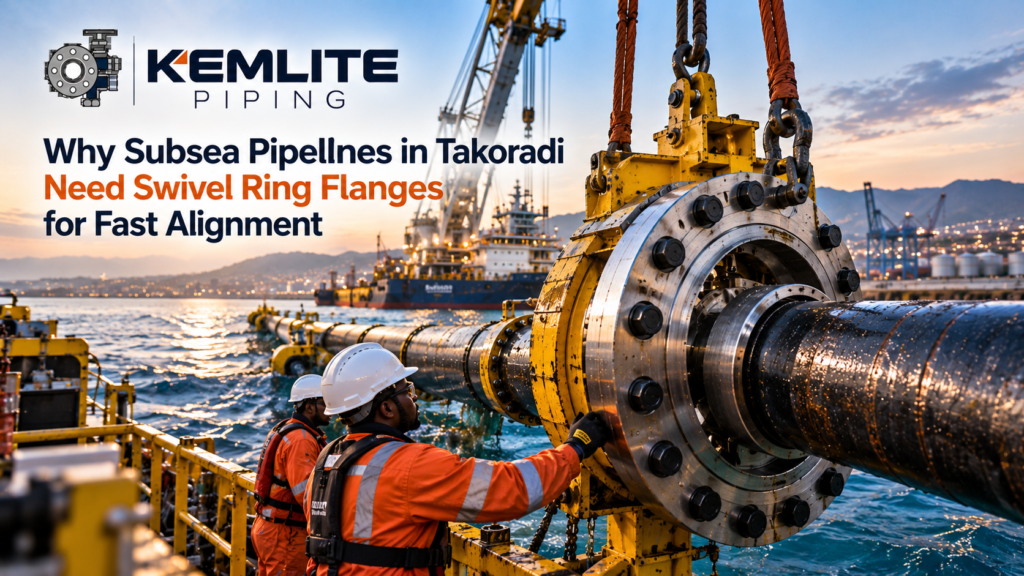
Smart offshore engineers eliminate this alignment nightmare by specifying a Swivel Flange on at least one side of the subsea tie-in. A swivel ring flange consists of two separate forged components: an inner welding hub that is butt-welded directly to the pipe end, and an outer forged ring containing the bolt holes that spins freely 360 degrees around the hub.
When the two pipe ends are brought together underwater, the diver doesn’t need to rotate the heavy pipe. They simply spin the outer flange ring by hand until the bolt holes line up with the mating flange, slide the Duplex or Teflon-coated stud bolts through, and torque the connection tight. Once bolted down, a swivel flange handles the exact same internal pressure and bending loads as a traditional one-piece weld-neck flange[cite: 4].
Kemlite Piping Solution manufactures heavy-wall swivel flanges designed specifically for offshore risers, subsea manifolds, and shallow-water tie-ins. We forge our hubs and rotating rings in Carbon Steel, Stainless Steel, and seawater-resistant Super Duplex S32750 / S32760 across pressure classes 150# to 2500#[cite: 4]. Every assembly undergoes strict ultrasonic and radiographic non-destructive testing before export[cite: 4]. Cut your offshore barge and diver time in half by building swivel flanges into your next West African subsea project.